
Intermediates
(S)-9-(2,3-Dihydroxypropyl)-N6-benzoyladenine
Quick view. An N6-benzoyl-protected, S-configured glycerol adenine intermediate used in GNA building-block synthesis workflows. CAS 59569-84-5. Catalog target purity: ≥98%. Availability: Inquiry only — contact BX Lab to confirm current availability.
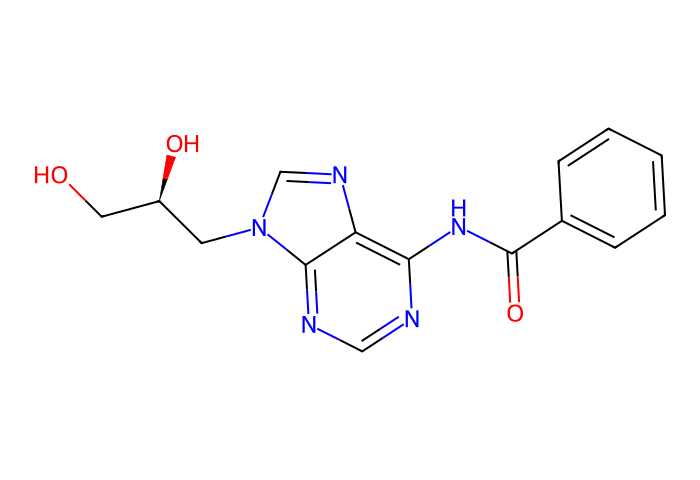
Product profile
(S)-9-(2,3-Dihydroxypropyl)-N6-benzoyladenine is classified as n6-benzoyl-protected gna adenine intermediate (Formula C15H15N5O3; molecular weight 313.31 g/mol).
(S)-9-(2,3-Dihydroxypropyl)-N6-benzoyladenine — Reported as an N6-protected adenine intermediate in synthetic routes to S-configured GNA building blocks.
For (S)-9-(2,3-Dihydroxypropyl)-N6-benzoyladenine, confirm the current specification, storage conditions and downstream-method compatibility before routine use.
Names and search terms
Confirmed or normalized name variants
- N6-Benzoyl-(S)-9-(2,3-dihydroxypropyl)adenine
Useful catalog search terms
- 59569-84-5
- N6-benzoyl S-GNA adenine
Physicochemical data
| InChIKey | WVGSSZDETQWOCC-NSHDSACASA-N |
|---|---|
| InChI | InChI=1S/C15H15N5O3/c21-7-11(22)6-20-9-18-12-13(16-8-17-14(12)20)19-15(23)10-4-2-1-3-5-10/h1-5,8-9,11,21-22H,6-7H2,(H,16,17,19,23)/t11-/m0/s1 |
| SMILES | O[C@@H](CN1C2=NC=NC(=C2N=C1)NC(C1=CC=CC=C1)=O)CO |
| Canonical SMILES | O[C@@H](CN1C2=NC=NC(=C2N=C1)NC(C1=CC=CC=C1)=O)CO |
Release documentation
The current specification defines the analytical method and acceptance criteria; the released lot result is reported on the CoA.
Additional HPLC, MS or NMR documentation can be agreed during technical review where available.
Related products
(2'OMe-5'p(S)-A)pG TEA Salt
Intermediates · CAS: 2295879-58-0
BX-INTE-0003(2'OMe-5'p-A)p(S)G TEA Salt
Intermediates · CAS: N/A
BX-INTE-0004(2'OMe-5'p-A)pG TEA Salt
Intermediates · CAS: 62828-60-8
BX-INTE-0005(2'OMe-5'p-A)pU TEA Salt
Intermediates · CAS: 2956650-76-1
BX-INTE-0006(2'OMe-5'p-G)pG TEA Salt
Intermediates · CAS: 2638447-65-9
BX-INTE-0007(2'OMe-5'p-U)pU Ammonium Salt
Intermediates · CAS: 57197-82-7
Frequently asked questions
Can the package size for (S)-9-(2,3-Dihydroxypropyl)-N6-benzoyladenine be customized?
Yes. Share the initial quantity, expected future scale, delivery timeline and packaging preference for review.
What information should be included in a quote request?
Quote catalog number BX-INTE-0090 and CAS 59569-84-5, the intended research workflow, required quantity and any additional HPLC, MS or NMR documentation needed.
Product-relevant literature
The publications below discuss named chemistry or a structural feature represented by this product. They provide scientific context only and are not a BX Lab lot specification or product-performance claim.