
Halogenated Nucleosides
N1-(1,1,1-Trifluoroethyl)pseudouridine
Quick view. A trifluoroethyl-modified pseudouridine building block for structure-specific modified-nucleoside research. CAS 1613529-80-8. Catalog target purity: ≥98%. Availability: Inquiry only — contact BX Lab to confirm current availability.
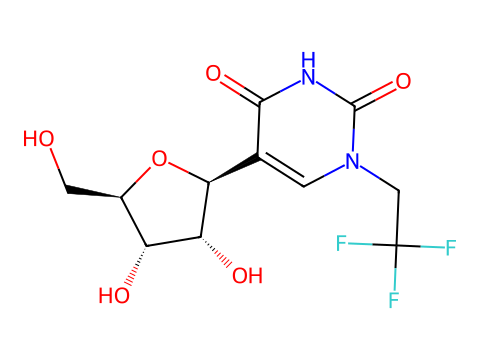
Product profile
N1-(1,1,1-Trifluoroethyl)pseudouridine is classified as halogenated nucleosides (Formula C11H13F3N2O6; molecular weight 326.23).
N1-(1,1,1-Trifluoroethyl)pseudouridine — Trifluoroethyl-modified pseudouridine building block for structure-specific modified-nucleoside research.
For N1-(1,1,1-Trifluoroethyl)pseudouridine, modification benefits are context-dependent; transcript length, substitution level, enzyme system and analytical purity can change the observed outcome.
Names and search terms
Useful catalog search terms
- CAS 1613529-80-8
Physicochemical data
| Nucleoside modification | N1-(1,1,1-trifluoroethyl) |
|---|---|
| PubChem CID | 90220691 |
| InChI | InChI=1S/C11H13F3N2O6/c12-11(13,14)3-16-1-4(9(20)15-10(16)21)8-7(19)6(18)5(2-17)22-8/h1,5-8,17-19H,2-3H2,(H,15,20,21)/t5-,6-,7-,8+/m1/s1 |
| InChIKey | NKQNAEGJFNGCQR-XUTVFYLZSA-N |
| SMILES | C1=C(C(=O)NC(=O)N1CC(F)(F)F)[C@H]2[C@@H]([C@@H]([C@H](O2)CO)O)O |
Release documentation
The current specification defines the analytical method and acceptance criteria; the released lot result is reported on the CoA.
Additional HPLC, MS or NMR documentation can be agreed during technical review where available.
Product-specific evaluation notes
Potential advantages
- Base modifications can tune RNA stability, translation behavior, duplex properties or analytical discrimination versus native bases.
- 2′-fluoro motifs can improve nuclease resistance while preserving RNA-like geometry in many sequence contexts.
Method limitations
- Modification benefits are context-dependent; transcript length, substitution level, enzyme system and analytical purity can change the observed outcome.
- Coupling, deprotection and biological performance remain sequence- and position-dependent.
These points describe N1-(1,1,1-Trifluoroethyl)pseudouridine or its named chemical feature. Broader product-family guidance is maintained on the category page.
Related products
Trifluridine
Halogenated Nucleosides · CAS: 70-00-8
BX-HN-00026-Chloropurine 2'-deoxyriboside
Halogenated Nucleosides · CAS: 4594-45-0
BX-HN-00038-Chloro-2'-deoxyadenosine
Halogenated Nucleosides · CAS: 85562-55-6
BX-HN-00042'-Chloro-2'-deoxycytidine
Halogenated Nucleosides · CAS: 10212-19-8
BX-HN-00055-Bromo-2'-deoxycytidine
Halogenated Nucleosides · CAS: 1022-79-3
BX-HN-01535-Fluoro-2'-deoxycytidine
Halogenated Nucleosides · CAS: 10356-76-0
Frequently asked questions
Can the package size for N1-(1,1,1-Trifluoroethyl)pseudouridine be customized?
Yes. Share the initial quantity, expected future scale, delivery timeline and packaging preference for review.
What information should be included in a quote request?
Quote catalog number BX-HN-0175 and CAS 1613529-80-8, the intended research workflow, required quantity and any additional HPLC, MS or NMR documentation needed.
Feature and workflow background
These publications discuss a broader chemistry feature or workflow identified from the catalog name or product family. They are background reading only, not evidence for the exact BX Lab product, supplied form, lot specification, availability or performance.
Technology platforms
Catalog-derived platform membership for navigating related chemistry and verifiable product sets.